

Generative AI has moved beyond experimentation and into value creation. Claire Butcher, AI Solutions Consultant at Sabio Group, explains.
According to Google Cloud’s ROI of AI 2025 report, 88% of agentic AI early adopters report ROI from at least one GenAI use case, compared with 74% across all organisations. At the same time, research from Deloitte and McKinsey suggests many organisations still struggle to convert experimentation into enterprise-scale value.
When AI was experimental, accountability was academic. As soon as organisations start measuring revenue, cost reduction and operational improvement, accountability becomes commercial. Somebody will eventually be asked why the outcome did or didn’t happen.
And once that question is being asked, a more fundamental one follows: who is actually responsible for creating the outcome?
AI doesn’t deliver outcomes. Systems do
We talk about AI outcomes as though the model decides them. But businesses don’t invest in AI because they want AI. They invest because they want something to change. In the case of CX it’s lower cost to serve, better experiences, higher containment and faster resolutions.
Those outcomes rarely come from a model alone. They emerge from a web of interconnected decisions: data quality, system integrations, customer journey design, workflow orchestration, governance, quality management, adoption and relentless optimisation. The model shapes this, but it is one part of the system, not the whole of it.
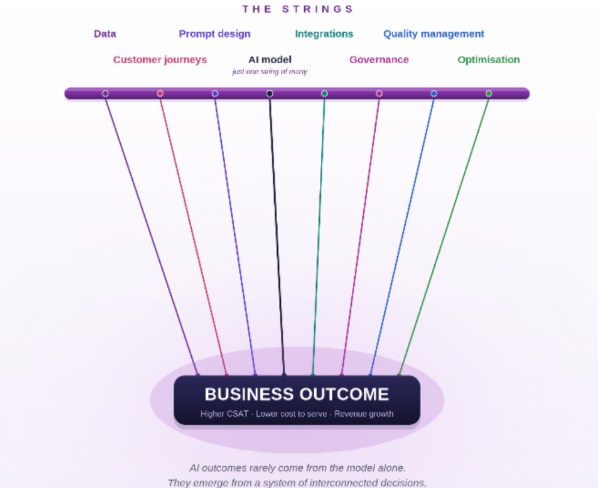
Who holds the strings?
Think of each of those decisions as a string, and different commercial setups hand a different share to a different organisation. Some are held by the customer, some by the technology vendor, some by the implementation partner, some by the managed service provider. The outcome depends on how they are pulled together, so the organisations holding the most strings have the greatest ability, and incentive, to shape the result.
Take a contact centre chasing lower cost to serve and higher first-contact resolution. Whether it gets there depends on far more than the model fielding the query: the knowledge the AI draws on, how cleanly it integrates with the CRM and case systems, and the feedback loop that turns real conversations into a better system next week. Pull any one of those strings and the outcome moves, often more than swapping the underlying model ever would.
Accountability should follow influence
As AI initiatives start delivering measurable outcomes, organisations become more interested in accountability for them. Who can influence the result? Who can improve it? Who can stand behind it?
The answers vary from programme to programme. An advisory partner influences strategy. A delivery partner influences design and implementation. A managed service provider influences ongoing performance. The customer drives adoption, operations and broader change. The principle underneath is simple: accountability should follow influence.
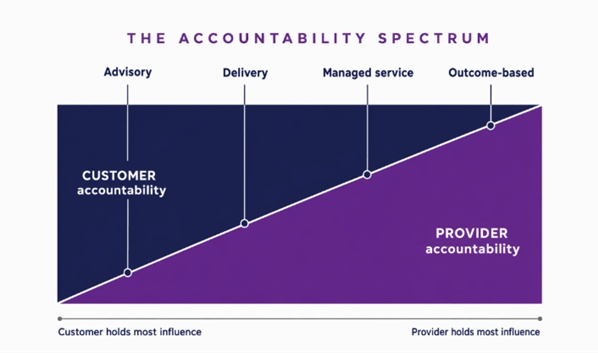
Which is also why not every programme should be outcome-based, and the honest test is narrower than who owns the platform or the data. An AI agent is not set and forget. Its performance comes from constant tuning: refining prompts, learning from real conversations, adjusting journeys and closing the feedback loop. Because of this, two things really decide the commercial model: how much freedom a customer will give us to alter the agent to improve it, and how willing they are to collaborate at the speed that improvement demands.
Where every change must route through slow sign-off, no supplier can move quickly enough to answer for the outcome, and a traditional mix of advisory, delivery and managed services is the honest fit. Where a customer lets us continuously tune the system and works alongside us at pace, we hold enough of the strings to stand behind the result. That is when outcome-based models become fair, and it is why we are adopting them: not because we grew more confident, but because influence and accountability finally line up.
The competitive advantage
Much of the industry is still fixated on models: GPT versus Gemini, open-source versus proprietary, large versus small. Yet most organisations still struggle to turn AI experiments into enterprise-wide value. The bottleneck is no longer access to AI, or the latest frontier model. It is execution.
Execution comes down to three things: a clearly defined problem, an agreed and measurable goal, and the freedom to keep working the solution until it hits that goal. Where these do not line up, no model will rescue the outcome. The organisations pulling ahead make sure the problem, the goal and the freedom to deliver sit with whoever can move the result. In other words, they know who holds the strings.
If you control the outcome, you can stand behind it
So before asking which model to back, map your own programme. List the variables that move your outcome, for example data, integration, journey design, governance, adoption and optimisation, and mark who holds each string. Then ask the two questions that really set the commercial model: how much freedom you will give a partner to keep tuning and improving the system, and how closely, and at what pace, you will work together to do it.
Wherever your programme sits on that spectrum, Sabio can help. We advise, design, deliver and run AI in the contact centre, and where we hold enough of the strings, we can do this in a way that means that you only pay for outcomes. Let’s work out which model fits yours.
We’ll be discussinig this, and more, at an AI Business Consultancy day we are hosting in Manchester on Tuesday, September 15th. You can find out more and register here.
About the Author
 Claire Butcher is AI Solutions Consultant at Sabio Group.