As your company grows, who should make the call when a customer needs help: one central support team or the people closest to that customer?
Decentralized customer service can give local teams room to act. Centralized support can make service easier to manage and more consistent.
Neither setup wins every time. Your customers’ needs, response times, costs, and company structure all matter. Start with the decisions your support team makes every day.
Is decentralized customer service better than centralized?
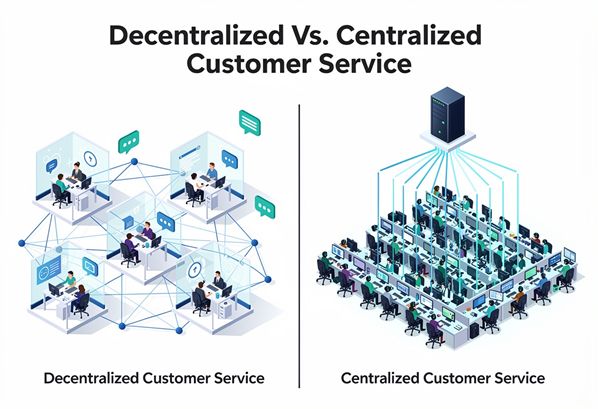
Decentralized customer service gives regional, store-level, or product teams authority to handle support decisions. Agents may work alongside local operations or in separate support groups. In a centralized model, a shared team manages customer requests under one leadership structure, with most decisions made through common policies and escalation paths.
Decentralized teams can respond faster and make service feel personal. Centralized teams often have an easier time maintaining consistent answers and quality checks. That distinction matters because expectations are high: Salesforce’s State of the Connected Customer found that 88% of customers say the experience a company provides is as important as its products or services. The figure shows why service deserves attention, not which structure to choose.
What centralized and decentralized support look like
Picture a retailer with stores across several regions. Under a centralized setup, every store sends customer questions to a shared support team. Under a decentralized setup, regional teams can approve routine returns or address delivery problems based on local conditions.
The distinction is about decision rights, not office addresses. A centralized team can have agents working in several cities. A decentralized company can put multiple teams in the same building while giving each authority over its own customers.
The trade-offs for customers and support teams
Local agents may know a region’s delivery patterns, language preferences, or product issues. That knowledge helps them tailor an answer without waiting for approval. But separate teams need shared training and policies. Otherwise, two customers with the same problem may get different solutions.
A central team can share specialist expertise, schedule agents across busy periods, and keep costs easier to track. Its weakness appears when agents must escalate ordinary requests or rely on scripts that don’t fit the situation. Consistency helps customers only when the answer is useful.
How the two customer service models compare in practice
What happens when a customer contacts support for the second time? Their patience depends less on your org chart than on whether the next agent knows what happened first. Zendesk’s 2023 CX Trends report found that 70% of consumers expect anyone they interact with to have full context of their previous conversations.
That expectation applies to both models. A shared customer record should show earlier contacts, purchases, and promised next steps. Clear handoff notes keep a transfer from becoming another request for the customer to explain everything again.
When centralized customer service works best
Centralized support often fits organizations that need tight quality control, shared technical expertise, or predictable staffing. It can also help when teams must follow the same compliance rules across many locations. A small pool of trained specialists may handle complex requests more reliably than asking every local team to build the same expertise.
Central control doesn’t have to mean a slow answer. Give agents access to customer history, publish clear rules for common exceptions, and set an escalation path for cases they can’t resolve. If approvals pile up, the process needs work even when the team sits together.
When local teams have the advantage
Regional or product teams are often better placed to solve issues shaped by language, inventory, local rules, or customer habits. A store team, for example, may know that a delayed order can be picked up nearby. Giving that team authority to offer the option can save a round of referrals.
Set limits before handing over that authority. Teams need training, accurate customer information, and a clear point at which a specialist takes over. Local judgment works best when agents know both what they can decide and what they must escalate.
How to choose the right customer service structure
Start with your customers and the requests they bring. Are most questions similar across locations, or do they depend on local products and conditions? Then look at staffing. A small company may struggle to keep specialists available in every region, while a larger business may have enough volume to support local teams.
Regulations and technology belong in the same decision. If agents can’t see a shared customer history, decentralizing decisions may create gaps. If every routine request needs central approval, the system may be too restrictive. Microsoft’s Global State of Customer Service report reports that 96% of consumers say customer service is important to their choice of and loyalty to a brand. That makes the tools and rules behind each interaction worth examining, regardless of the structure you pick.
Match authority to the work
Sort recent cases into routine requests, local exceptions, and complex or regulated issues. Note who could have resolved each one and what information they needed. This shows where approval delays occur and where a central specialist adds value.
Look at coverage, too. If a regional team can’t reliably staff evenings, a shared team may need to handle requests outside local hours. Customers shouldn’t have to know which team is on duty to get an answer.
Why a hybrid model may offer the best balance
A hybrid approach keeps standards, training, customer data, and quality checks central while letting frontline teams settle routine issues. A retailer might set one returns policy, then allow store teams to approve exchanges within defined limits. Unusual claims go to a shared specialist.
Write down those limits. Who can issue a refund? Who handles a complaint involving a regulated product? Clear answers prevent customers from being passed between teams. They also give managers a fair way to review decisions without taking every decision away from agents.
Choose the structure your customers can feel working
The better model depends on what customers need and how your business operates. Central oversight with local authority is often a practical place to start, provided each team knows its role.
Then check customer feedback, resolution time, and service consistency. Those results will tell you more than the org chart.
Related Articles:

How to Make Automated Customer Experience More Human

Social Media Standards for Customer Service Managers

Saying “I’m Sorry” Isn’t Enough: The Real Secret to Keeping Customers

First Call Resolution for Voice Agents: When a Resolved Call Leads to Another Call

Top 7 AI Sales Assistants for Discovery Calls