
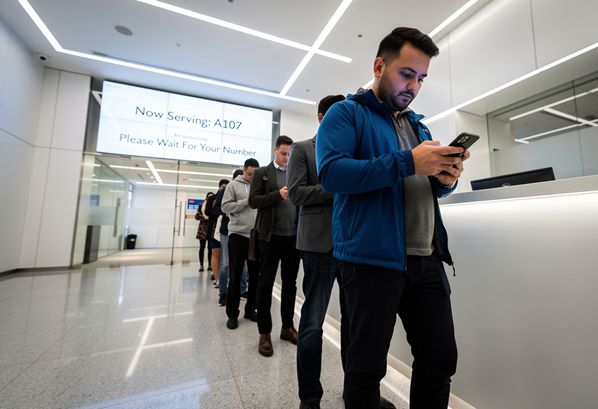
Nobody likes standing in line. Whether trapped under the fluorescent lights of a government building, pacing an overcrowded clinic waiting room, or waiting for a cashier, queueing has long felt like an exercise in wasted time.
In customer psychology, waiting is toxic: unoccupied time feels longer than occupied time, and uncertain waits breed anxiety. Historically, businesses addressed this with paper tickets and noisy overhead intercoms—a minor upgrade to an inherently broken experience.
Driven by mobile connectivity, cloud software, and predictive analytics, smart queue management systems (SQMS) are eliminating physical queues altogether. Instead of trapping customers in waiting rooms, forward-thinking organizations are giving them their time back—transforming an operational bottleneck into a competitive advantage.
What Is a Smart Queue Management System?
A smart queue management system replaces physical lines with a virtual waitlist.
Instead of taking a paper ticket and remaining tethered to a lobby, customers check in via:
- QR codes scanned with a smartphone camera
- Self-service kiosks at the entrance
- SMS or mobile apps before they even arrive
- Website appointment portals
Once registered, customers receive real-time updates via SMS, WhatsApp, or in-app alerts showing their exact place in line and estimated wait time. They are free to grab a coffee, run errands, or wait in their car. When their turn approaches, an automated notification summons them directly to the appropriate service counter.
By decoupling the wait from the location, businesses eliminate friction before a service interaction even begins.
Why Brands Are Ditching the Line
Smart queuing isn’t just a courtesy—it directly impacts the bottom line:
- Slashes “Perceived” Wait Times: Psychology shows that knowing how long you will wait makes the duration feel significantly shorter. Transparency replaces anxiety with control.
- Reduces “Balking” and “Reneging”: In retail and hospitality, visible long lines deter walk-ins (balking) and cause waiting customers to abandon their visits (reneging). Virtual queues keep customers engaged and committed.
- Optimizes Staff Allocation: Instead of reacting to sudden rushes, managers can monitor real-time queue dashboards to balance counter loads, cross-train staff, and dispatch help where bottlenecks occur.
- Unlocks Rich Operational Analytics: Traditional queues leave no digital footprint. Smart systems track average wait times, transaction speeds by employee, peak traffic hours, and customer drop-off rates, enabling data-backed staffing decisions.
Real-World Impact Across Sectors
- Healthcare: Eliminates overcrowded waiting rooms, reduces cross-contamination risks, and prioritizes patients dynamically based on triage urgency rather than simple arrival time.
- Banking & Financial Services: Routes customers to the correct specialist (e.g., mortgage advisor vs. standard teller) upon check-in, reducing handoffs and transaction times.
- Retail & Telcos: Allows customers to browse store merchandise rather than being pinned to a checkout counter, driving impulse purchases and lifting average basket sizes.
- Government & Public Sector: Transforms notoriously slow public offices into orderly, appointment-driven service hubs, rebuilding public trust and cutting citizen complaints.
Smart Queue Management Software Vendors
As the market expands, several software providers have emerged as leaders across different industries and organizational sizes:
1. Qmatic
- Best for: Enterprise, global healthcare networks, and large public sector institutions.
- Why they lead: Qmatic is an industry pioneer operating in over 120 countries. They offer robust, enterprise-grade customer journey management platforms combining cloud software with heavy-duty physical kiosks, digital signage, and hardware terminals.
- Key Strengths: Advanced security compliance, deep ERP/CRM integrations, and unmatched scalability for massive public deployments.
2. Waitwhile
- Best for: Retail, enterprise, hospitality, and tech-forward service brands.
- Why they lead: Waitwhile combines a sleek, modern consumer interface with powerful developer tools. It requires zero hardware—running entirely on mobile devices, web browsers, and SMS.
- Key Strengths: Highly customizable API, rapid deployment, automated two-way SMS messaging, and predictive wait-time algorithms driven by machine learning.
3. Qminder
- Best for: Walk-in service locations, universities, and retail branch networks.
- Why they lead: Designed for simplicity, Qminder uses iPad check-in kiosks paired with clear digital lobby screens and clerk dashboards. It focuses on humanizing the waiting experience by greeting customers by name rather than a number.
- Key Strengths: Minimal setup time, clean interface, out-of-the-box business intelligence dashboards, and native Service Cloud/CRM integrations.
4. Wavetec
- Best for: Financial services, telecom flagships, and high-foot-traffic environments.
- Why they lead: Wavetec specializes in comprehensive enterprise hardware-software ecosystems. From WhatsApp-based queue booking to interactive self-service kiosks and LED counter displays, they excel in complex physical environments.
- Key Strengths: WhatsApp integration (no app download needed for customers), end-to-end hardware manufacturing, and global enterprise support.
5. ACF Technologies
- Best for: Government agencies, DMVs, courts, and university admissions.
- Why they lead: ACF specializes in complex workflows where customer interactions require multiple stages.
- Key Strengths: Multi-step journey mapping, custom logic routing, case-management functionality, and strict public-sector compliance.
Predictive AI and Invisible Service
The queue management space is rapidly moving beyond simple digital lists. Modern platforms are integrating predictive artificial intelligence:
- Demand Forecasting: Systems analyze historical foot traffic, weather patterns, and calendar events to predict rush hours days in advance, automatically generating optimized employee shift schedules.
- Dynamic Routing: AI engines route customers to specific reps based on real-time agent skill ratings, current transaction velocity, and the customer’s value tier.
- Geo-Fencing: Mobile systems track customer arrival via GPS, automatically checking them in the moment they pull into the parking lot.
The Takeaway
Customer patience is at an all-time low, but expectations for seamless, respectful service are at an all-time high.
Smart queue management is no longer a luxury reserved for cutting-edge tech stores; it is rapidly becoming baseline infrastructure across every customer-facing industry. In a competitive market, organizations won’t necessarily win by eliminating wait times entirely—they will win by making the wait transparent, painless, and completely invisible.