

In the competitive world of home improvement retail, tile stores face unique challenges that extend far beyond simply stocking attractive products.
Whilst beautiful tiles might initially draw customers through the door, it’s the quality of customer service that determines whether they’ll make a purchase, return for future projects, and recommend your business to others.
In an industry where purchases are often significant investments tied to important life events—renovations, new home purchases, or business developments—the role of exceptional customer service cannot be overstated.
Unlike purchasing everyday items, buying tiles represents a considerable commitment. Customers must navigate complex decisions about materials, quantities, aesthetics, and practicality, often without the technical knowledge to make these choices confidently. This is where your customer service becomes not merely a pleasant addition to the shopping experience, but an essential component of your value proposition. The tile store that recognises this fundamental truth positions itself for long-term success and sustainable growth.
Building Trust Through Expert Guidance
One of the primary reasons customers visit a tile store rather than ordering online is the desire for expert advice. Homeowners and contractors alike need assurance that they’re making the right choices for their specific applications. When your staff members possess comprehensive product knowledge and can articulate the differences between porcelain and ceramic, explain the benefits of large-format tiles versus mosaics, or advise on appropriate adhesives and grouts, they transform a potentially overwhelming experience into an educational journey.
This expertise builds trust, which is currency in the tile retail business. A customer who trusts your guidance is more likely to purchase higher-quality products, buy additional materials they hadn’t initially considered, and return when the next project arises. Moreover, they become ambassadors for your business, sharing their positive experiences with friends, family, and colleagues who are undertaking similar projects.
Training your team to develop this expertise should be a continuous investment. Product knowledge sessions, manufacturer partnerships, and hands-on experience with installation challenges all contribute to creating staff members who can genuinely help customers navigate their options with confidence.
Managing the Complexity of Tile Purchases
Tile purchases involve numerous variables that can befuddle even experienced renovators. Calculating quantities with appropriate wastage allowances, understanding the implications of different tile sizes on installation complexity, coordinating delivery schedules with project timelines, and managing returns or exchanges all require careful attention and clear communication.
Exceptional customer service in these areas means anticipating problems before they occur.
It means asking the right questions about the installation environment—is this a high-moisture area? Will there be underfloor heating? What substrate will the tiles be fixed to?—and providing guidance accordingly. It involves double-checking calculations, explaining why ordering extra tiles is wise, and making the returns process straightforward when customers inevitably over-order.
When customers feel that your team is actively working to prevent costly mistakes and project delays, they perceive tremendous value beyond the physical products. This service becomes a differentiator that justifies premium pricing and builds customer loyalty in ways that discounting never can.
Creating an Inspiring Showroom Experience
The physical environment of your tile store serves as a canvas upon which customer service is delivered. A well-organised showroom with thoughtfully arranged displays doesn’t merely showcase products; it demonstrates your commitment to the customer experience. However, the most beautiful showroom falls short without staff members who can bring these displays to life through attentive service.
Greeting customers promptly without being intrusive, gauging their need for assistance versus independent browsing, and being available without hovering—these subtle aspects of customer service create the comfortable atmosphere in which purchasing decisions are made. Staff should be trained to read customer cues, understanding when someone needs immediate help with a specific question versus when they’re in the exploratory phase and prefer to browse before engaging.
Additionally, offering amenities that make the shopping experience more comfortable—seating areas for customers to review samples and plans, refreshments, and adequate lighting to assess colours accurately—all signal that you value your customers’ time and comfort.
Handling Complaints and Resolving Issues
No matter how excellent your products and service, problems will occasionally arise. A batch of tiles might have variation that exceeds expectations, delivery might be delayed, or a product might not perform as a customer anticipated. How you handle these situations defines your customer service philosophy and can either destroy or strengthen customer relationships.
Empowering your staff to resolve issues quickly and fairly demonstrates confidence in your business practices and respect for your customers’ concerns. This might mean accepting returns beyond standard policies in exceptional circumstances, expediting replacement orders, or offering solutions that meet customers halfway when fault is unclear.
Viewing complaints as opportunities rather than nuisances transforms these challenging interactions into relationship-building moments. A customer whose problem is resolved efficiently and empathetically often becomes more loyal than one who never experienced an issue at all.
Supporting Customers Throughout the Project Journey
The customer relationship shouldn’t end at the point of sale. Following up to ensure delivery occurred as scheduled, checking whether the installation is progressing smoothly, and being available to answer questions that arise during the fitting process all extend the customer service experience beyond the transaction.
This ongoing support might include maintaining a library of care and maintenance instructions, offering recommendations for reliable installers, or providing technical support when installation challenges emerge. Some tile stores enhance this service by offering workshops on tile selection, maintenance, or even basic DIY installation techniques.
These extended touchpoints keep your business at the forefront of customers’ minds and position you as a partner in their project rather than simply a supplier. When the time comes for their next project or when friends seek recommendations, this relationship pays dividends.
Leveraging Technology Without Losing the Personal Touch
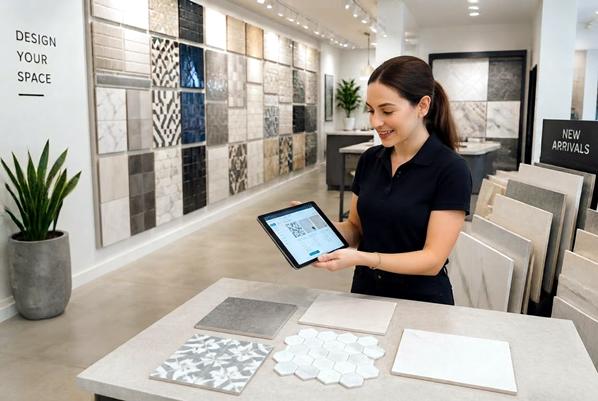
Modern customers expect certain technological conveniences—online browsing of inventory, digital visualisation tools, or the ability to check stock availability remotely. Integrating these technologies into your customer service approach enhances rather than replaces personal interaction.
For instance, allowing customers to browse your inventory online and save favourites before visiting ensures that in-store time is spent more productively with staff assistance. Digital room visualisation tools help customers see their selections in context, reducing uncertainty and return rates. However, these tools should complement expert staff guidance rather than substitute for it.
The most successful tile stores use technology to streamline transactional elements, freeing staff to focus on the high-value interactions where human expertise and empathy truly make a difference.
The Commercial Benefits of Service Excellence
Whilst the ethical case for excellent customer service is compelling, the commercial benefits are equally powerful. Customer acquisition costs continue to rise across retail sectors, making retention increasingly valuable. A satisfied customer represents not just their initial purchase but potentially decades of repeat business and referrals.
Research consistently shows that customers will pay premium prices for superior service, particularly in categories like home improvement where mistakes are costly. Your customer service becomes a competitive advantage that’s difficult for competitors to replicate, unlike pricing or product selection, which can be matched relatively easily.
Furthermore, businesses known for exceptional service attract higher-quality employees who take pride in their work and contribute to a positive workplace culture, creating a virtuous cycle of excellence.
Conclusion
In the tile retail business, your products tell only half the story. The other half—arguably the more important half—is written through every customer interaction, from the initial greeting to post-installation follow-up. Exceptional customer service transforms your tile store from a mere supplier into a trusted advisor and partner in your customers’ most important projects.
By investing in staff training, creating systems that support positive customer experiences, and fostering a culture where service excellence is valued and rewarded, you build a sustainable competitive advantage that transcends market fluctuations and competitive pressures. In an industry where word-of-mouth recommendations and repeat business are invaluable, there is no greater investment than in the quality of service you provide each day.