

A customer complaint is often the final signal of a problem that has been sitting in plain sight for days or weeks.
Learning to spot root causes before they become customer complaints gives your team time to fix the process before trust slips away. That matters because 32% of customers would leave a brand they love after one bad experience, according to PwC.
10 ways to spot root causes before they become customer complaints
Don’t wait for complaint volume to rise. The useful clues usually sit across customer behavior, employee observations, and operational data. When those clues point in the same direction, you have a problem worth investigating.
Track small changes in customer behavior before they become a pattern
Watch for rising help-center searches, abandoned carts, refund requests, repeat contacts, low survey scores, and reduced product use. One angry message may be an outlier. A small weekly rise in “Where is my order?” searches is usually not.
Break trends down by product, channel, location, and customer type. A drop in usage among new mobile customers may disappear in your overall average. That doesn’t make it less real.
Map the customer journey to find friction between handoffs
Walk through the journey as your customer does, purchase, delivery, setup, support, and renewal. Then look hardest at the handoffs.
Sales may promise a delivery date that operations can’t see. Billing may require duplicate data entry. Support may lack a status update after a shipment exception. These gaps create confusion because no one owns the full path.
Listen to frontline employees who see problems first
Support agents, drivers, account managers, and store employees hear the same questions before leaders see a dashboard change. Give them a simple way to report recurring issues each week.
Group similar observations, assign someone to investigate, and report back on what happened. If people get blamed for raising risks, they’ll stop raising them. Psychological safety isn’t a slogan here. It’s how you learn about trouble early.
Use support conversations and reviews as early warning data
Chat logs, call recordings, emails, social comments, product reviews, and cancellation reasons contain plain-language clues. Code repeated themes such as “confusing instructions,” “unexpected fee,” or “can’t reset password.”
AI can group large volumes of conversations quickly, but people should check the results. A tool may combine two complaints that sound alike but have different causes.
Watch operational metrics that predict customer frustration
Leading measures show pressure before customers feel the full impact. Track order cycle time, backlog age, first response time, defect rates, stockouts, failed payments, delivery exceptions, and repeat contacts.
Research from SQM Group links each one-point improvement in first-call resolution with a one-point reduction in contact center operating costs. The exact result will vary, but the lesson is clear: resolving the issue the first time protects both customers and costs.
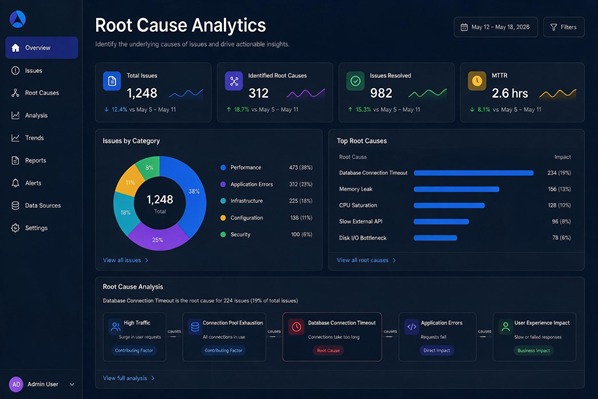
Turn early signals into customer complaint prevention
Finding a signal is only half the job. To spot root causes before they become customer complaints, your team must confirm what caused the issue, repair the process, and check whether the repair holds.
Rank issues by customer impact, frequency, risk, and cost. A rare failed payment affecting a high-value account may deserve faster action than a common but minor question.
Ask why repeatedly until the process failure is clear (5 Whys)
To truly solve a problem, you must look beyond surface-level symptoms and individual mistakes. The 5 Whys method is a root-cause analysis tool designed to move past blame and uncover the underlying process failure. By asking “Why?” five times, you peel back the layers of a problem to find a solution that prevents it from happening again.
Problem Statement: Customers are receiving their shipments later than the promised delivery date.
- Why are the shipments late?
- Because the orders are reaching the warehouse loading dock later than scheduled.
- Why are the orders reaching the warehouse late?
- Because the sales team is taking longer than expected to process and hand off the paperwork.
- Why is the sales team delayed in processing the paperwork?
- Because they have to manually re-enter customer data from the legacy ordering system into the new shipping software.
- Why are they manually re-entering data instead of using an automated system?
- Because the automated integration between the two systems has been failing intermittently for the last month.
- Why has the integration been failing? (Root Cause)
- Because the IT department’s maintenance budget was cut, and the API subscription required for the integration was allowed to expire.
If you had stopped at the first or second “Why,” you might have blamed the warehouse staff for being slow or the sales team for being inefficient. You might have tried to “solve” the problem by telling employees to work faster.
However, by reaching the fifth Why, you discovered that the real issue is a budget and software licensing failure. The solution isn’t to blame people; it’s to fix the process by renewing the API subscription and ensuring the IT budget covers essential integrations
Compare complaints across products, channels, and customer groups
Overall averages can hide a serious issue. Compare complaint themes by customer segment, product version, region, device, order size, customer tenure, support channel, and time of day.
For example, a low number of setup complaints may look harmless until you see that nearly all of them come from new customers using one Android version. Low volume still matters when affected customers are high value or face safety-related risks.
Test the fix on a small scale before changing everything
Run a controlled pilot when possible. Try a revised shipping rule with one warehouse, a clearer setup email with a sample customer group, or a new support script for one queue.
Set a baseline first. Measure repeat contacts, delivery speed, completion rates, refunds, and customer effort. Watch for side effects too. Lowering handle time isn’t a win if customers need to call back twice.
Create owners, deadlines, and alerts for recurring risks
Put each finding into an action log with the root cause, supporting evidence, owner, due date, corrective action, and follow-up metric. Vague ownership is where good findings go to die.
Set thresholds that trigger review before customers are affected at scale. Microsoft reports that 90% of Americans consider customer service when deciding whether to do business with a company. A recurring failure deserves a named owner.
Review whether the problem stayed fixed, not just whether complaints fell
A short-term drop in complaints doesn’t prove success. Customers may leave without reporting the problem, or they may have stopped trying to get help.
Review the issue after 30, 60, and 90 days. Check complaint trends alongside retention, refunds, customer effort, operational data, and employee feedback.
For a small team, hold a weekly 30-minute review. Pick one recurring issue, examine the evidence, assign one action, and revisit last week’s fix.
Catch the Problem Before the Customer Does
Complaints are useful signals, but the strongest teams act on earlier evidence. They watch behavior and operations, listen to employees and customers, test the suspected root cause, and keep ownership clear.